
Waukesha Epoxy Flooring grinds and finishes polished concrete floors in Waukesha, WI, serving surrounding cities including Pewaukee, New Berlin, Brookfield, Hartland and Delafield. After more than 20 years of working on local slabs, we treat polishing as concrete work first and finish work second, because the floor you end up with is decided by the slab, the grind depth and the densifier long before the last diamond touches it.
A polished floor has no film on top to peel, blister or wear through, which is why it has become a common choice for retail floors, offices, warehouses, showrooms and shop spaces around Waukesha County. It is also honest about the concrete underneath: the aggregate, the color and the trowel history of the slab all show in the finish, so we grind a test area before quoting and let you see your own floor rather than a sample.
Every proposal names the target aggregate exposure, the densifier, the grit sequence and the finished sheen, so the floor that is quoted can be checked against the floor that is delivered. If a slab is too soft, too patched or too damaged to polish well, we say so up front and talk through a coated system instead.
How a Polished Concrete Floor Is Built
Grinding to the Chosen Aggregate Exposure
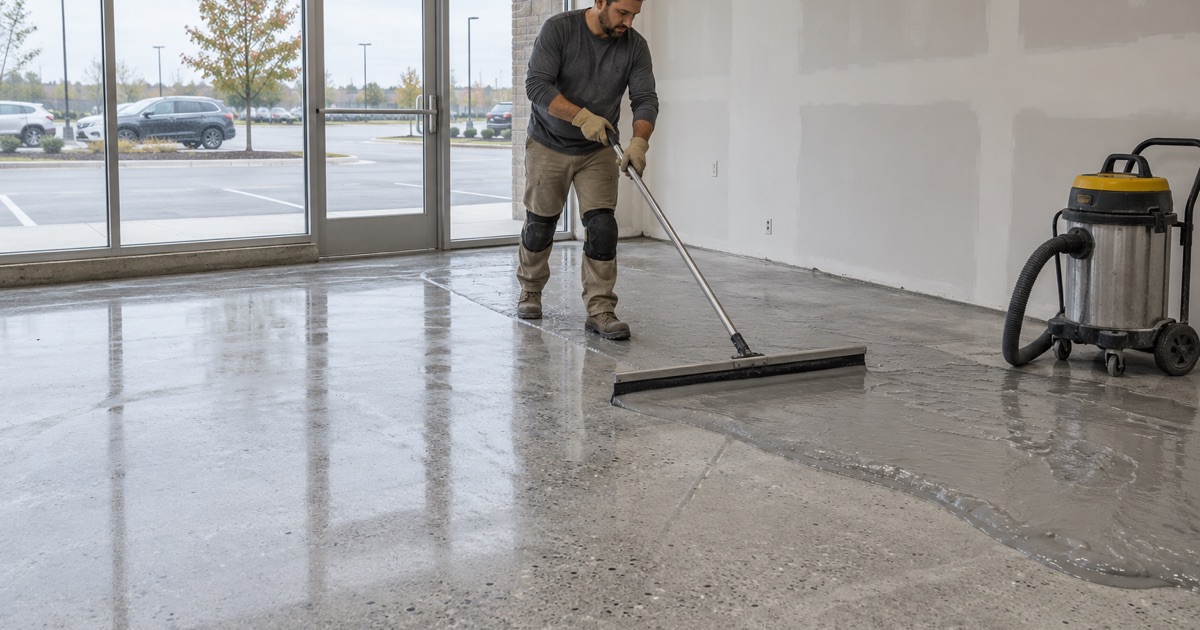
Polishing starts with coarse metal-bond diamonds that flatten the slab and cut down to the exposure you picked. A light grind leaves a cream finish showing almost no stone, a slightly deeper cut brings out fine salt-and-pepper aggregate, and a full grind exposes the larger stone across the floor. The deeper the cut, the more material comes off and the longer the job runs.
That choice has to be made before work starts, because grinding cannot be undone. We show the three looks on your slab in a small test area, since two floors poured from different mixes can look completely different at the same depth.
Densifying With Lithium Silicate
Once the slab is ground and opened up, we apply a lithium silicate densifier. It reacts with the free lime in the concrete to form a harder, denser surface that resists abrasion and dusting and takes a polish far better than untreated concrete. Densifying at the right point in the sequence is what lets the later resin-bond diamonds build a lasting shine.
A densifier is not a coating. It soaks in rather than sitting on top, so it does not change the color of the floor and cannot peel. On softer slabs we may apply it twice, once early in the grind and again before the final passes.
Refining and Polishing to a Sheen Level
After densifying, we step through finer resin-bond diamonds, refining the scratch pattern left by each previous grit until the surface begins to reflect light. Where the sequence stops sets the sheen: a satin finish stops earlier, while a high-gloss floor carries on through the finest grits.
A final guard or stain protector is often added to help the surface shed spills between cleanings. It is thin and can be refreshed during routine maintenance, which keeps the floor protected without turning it back into a coated floor.
Where Polished Concrete Works, and Where It Does Not
Retail, Office and Showroom Floors
Polished concrete suits retail sales floors, office suites, showrooms and lobbies, where foot traffic is constant and owners want a floor that cleans with an auto-scrubber and never needs stripping and waxing. The reflective surface can also brighten a space with the lighting already in it.
For occupied buildings we plan the work in zones and around business hours, and our grinders run with vacuum dust collection. Because there is no coating to cure, a polished area can usually be walked on soon after the final pass, which helps a store or office reopen on schedule.
Warehouses, Shops and Light Industrial Floors
In warehouses and light industrial buildings, a densified and polished slab stands up to pallet jacks, carts and steady forklift traffic without the risk of a coating wearing through in the drive aisles. Joints still matter: we fill them with a semirigid joint filler so wheel traffic crosses a supported edge rather than chipping it.
Polished concrete is less forgiving where oils, acids or harsh cleaners sit on the floor for long periods. In machining areas, battery charging rooms or food processing spaces, we often recommend a resin coating instead, and we explain why in the proposal rather than pushing one system for every room.
Basements and Homes
In a dry, finished basement, polished concrete gives a durable floor that works with area rugs and radiant warmth from the slab. We still test for moisture first, because a damp slab will show staining and efflorescence through a polished surface, and no polish can hide water moving through the concrete.
Garages are a different story in Waukesha. Road salt brine and dripping oil stain and etch a polished slab, so for a garage we usually recommend a broadcast coating with a sealed topcoat, and we tell you that plainly when we see the space.
Color, Patching and Old Floor Coverings
Dyes, Stains and Saw-Cut Designs
Color can be added to polished concrete with dyes or stains applied during the grinding sequence, before the floor is fully refined, so the color sits in the surface. Saw-cut lines can separate color fields, outline borders or follow the existing control joints for a cleaner look.
Because the base color of each slab varies, we test a dye on your floor before committing to the full area. A gray slab and a warmer, sand-colored slab will take the same dye very differently.
Patches, Cracks and Removing Old Coverings
Old carpet adhesive, mastic, paint and failed coatings have to come off before a slab can be polished, and they come off by grinding, which adds time to the job. Cracks and spalls are filled with a material chosen to blend as closely as possible, though repairs always remain visible to some degree in a polished floor.
We tell you before we start how the patched areas are likely to read in the final finish. If a slab carries so many repairs that a polished look would disappoint, a coated system may be the better answer.
Cost, Upkeep and Long-Term Wear
What Moves the Price of a Polished Floor
The biggest factors in the price of polished concrete are the square footage, the depth of the grind, and what has to come off the slab before polishing can begin. A cream finish on a clean, flat slab is the quickest version of the job, while a full aggregate exposure through old mastic and patched areas takes far more passes and far more diamond tooling.
Color, saw-cut borders and the final sheen add their own lines. We price each of those separately in the proposal, so you can see which choices drive the number and trade a gloss level or a design detail against the budget rather than guessing.
Keeping the Shine Through a Salt Season
Road salt and deicer residue tracked in from Waukesha parking lots are the main enemy of a polished entry. Left on the floor, the residue dulls the surface and leaves a white haze that a dry mop only spreads around. Walk-off mats at each door and a neutral cleaner in the auto-scrubber during the winter months keep it from building up.
Over years of traffic, the busiest lanes lose some sheen first. Because the shine is in the concrete rather than in a film, those lanes can be burnished or re-polished with fine diamonds without closing the whole floor, which is a large part of why polished concrete costs so little to keep.
Dust and Slurry Control on Every Job
Dry grinding runs with vacuum dust collection, and any wet grinding slurry is collected and hauled away. None of it is washed into a floor drain or storm inlet, which keeps the job within the Waukesha sewer use limits on solids discharged to a sewer and keeps the building clean while we work.
- 20+ Years Coating Concrete
- Moisture Testing in Every Scope
- Written Contract Before Any Deposit