
Waukesha Epoxy Flooring provides concrete grinding and shot blasting in Waukesha, WI, serving surrounding cities including Pewaukee, New Berlin, Brookfield, Hartland and Delafield. Surface preparation is the part of a floor job nobody sees once it is finished, and it is the part that decides whether a coating stays bonded for years or peels in sheets within a season. In more than 20 years of coating concrete, the single most common failure we have been called to fix is a coating applied to a slab that was never properly opened up.
Every slab we coat is prepared mechanically, with a diamond grinder or a shot blaster, and we do not acid etch. We also offer grinding as a stand-alone service: removing old coatings and adhesives ahead of another flooring trade, flattening lips at joints, or preparing a slab for polishing. Whatever the job, the target surface profile and the areas covered are written into the proposal.
Good preparation also tells us about the slab. Grinding exposes cracks, soft spots, old patches and moisture staining that a coating would have hidden, so we read the floor as we go and say plainly when it needs repair or replacement before anything goes on it.
Grinding, Shot Blasting and Surface Profile
Diamond Grinding
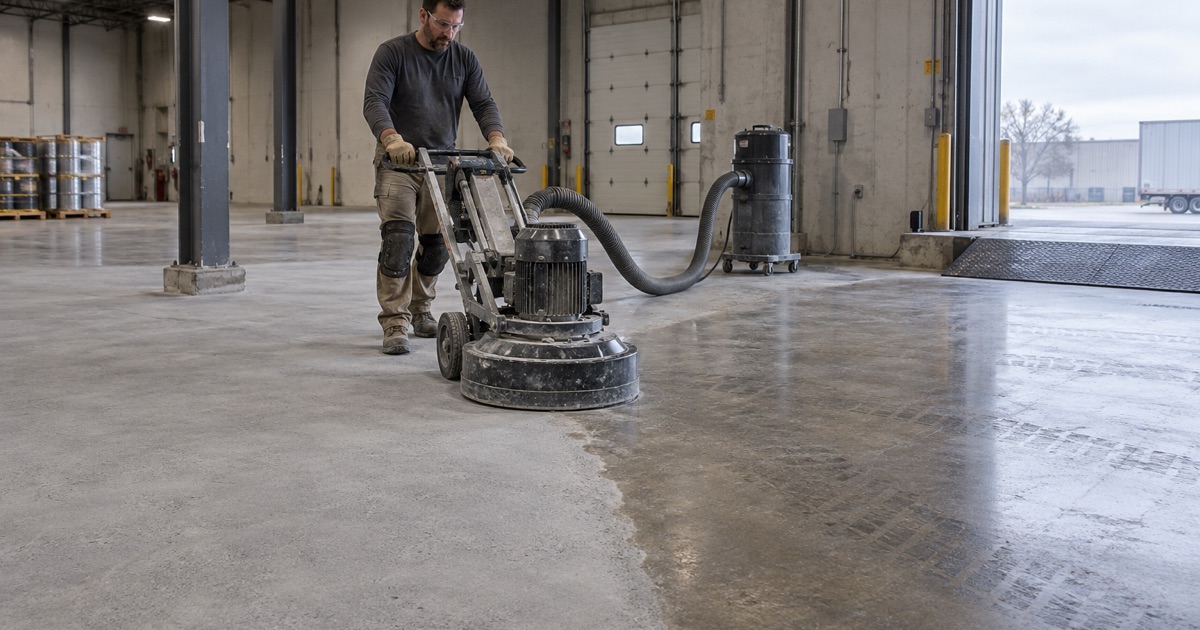
A planetary diamond grinder uses rotating heads fitted with metal-bond or resin-bond diamond segments to cut the top of the slab. Coarse metal segments remove coatings, adhesives and the weak cement paste on top; finer tooling smooths the surface for thin systems or polishing. Grinding works well in garages, basements, and rooms with walls, columns and fixtures to work around, and edge grinders reach the last inches along the walls.
The diamonds are chosen for the concrete as well as the job. A hard, dense slab polishes the diamonds dull if the bond is too hard, while a soft slab wears segments down quickly, so we test a small area first and change tooling until the cut is clean and consistent across the floor.
Shot Blasting
A shot blaster throws steel shot at the slab and recovers it in the same pass, leaving a uniform, textured profile. It is fast on large open floors such as warehouses and plants and is well suited to the heavier profiles thick mortars and urethane cement systems need. Edges and corners still need grinding, so large jobs often use both.
Shot blasting is less suited to a finished basement or a small residential garage, where the machine size and the steel shot are more than the job needs. It also leaves a pattern that can show through very thin coatings, so we keep it for systems built thick enough to cover it.
Matching the ICRI Profile to the System
The International Concrete Repair Institute describes surface roughness on a CSP scale from 1 to 10. A thin sealer or coating needs a light profile, a broadcast epoxy floor a moderate one, and a troweled mortar or urethane cement a heavy one. Too smooth and the coating has nothing to grip; too rough and a thin coating cannot cover the peaks. We choose the tooling for the profile the system calls for and check it before anything is applied.
We compare the prepared floor against ICRI’s reference chips, which are rubber replicas of each profile, rather than judging roughness by eye. That check goes in the job record, so if a coating is ever questioned there is a documented answer about how the slab was prepared.
Removing What Is Already There
Old Coatings, Paint and Sealers
Painted garage floors, peeling kit coatings and cure-and-seal products all have to come off before a new system can bond to the concrete. Some come off quickly; well-bonded industrial coatings can take several passes. A sealer may be invisible, so we test how water beads on the slab and grind until the concrete absorbs it evenly.
Removing an old coating also reveals what was under it. Cracks that were painted over, patches that never bonded, and dark moisture staining all show up once the slab is bare, and we walk you through anything that changes the scope before moving on to repair or coating.
Carpet Glue, Mastic and Thinset
Adhesives and tile setting materials are common in basements and older commercial spaces. Soft adhesives clog diamonds quickly, so we use tooling made for them and sometimes scrape the bulk off first. Old black mastic in some older buildings can contain asbestos, and where that is possible it should be tested before any grinding starts.
Oil, Grease and Contamination
In auto shops, machining areas and some garages, oil has soaked into the concrete. Grinding removes the surface staining, but deep saturation may need cleaning and further grinding before a coating will bond. We test the cleaned surface rather than assuming the stain is gone.
Flattening Joints, Lips and High Spots
Slab edges at control joints often curl or settle unevenly, leaving lips that catch cart wheels and show through thin coatings. Grinding takes those lips down so the floor reads as one plane. We can also grind high spots and trowel ridges before a metallic or polished finish, where every imperfection shows. Low areas are filled with a repair or leveling material rather than ground, since grinding cannot raise a floor.
Dust and Slurry Control
Our grinders run with vacuum dust collection connected directly to the cutting head, and the work area is closed off from the rest of the home or building. Dust is bagged and hauled away. Where wet methods are used, the slurry is contained and removed. Waukesha’s sewer use rules bar discharging solids and slurries that can obstruct a sewer, so none of it goes down a floor drain, a sump or a storm inlet.
- 20+ Years Coating Concrete
- Moisture Testing in Every Scope
- Written Contract Before Any Deposit