Waukesha Epoxy Flooring installs metallic epoxy floor systems in Waukesha, WI, serving surrounding cities including Pewaukee, New Berlin, Brookfield, Hartland and Delafield. A metallic floor is the most decorative system we pour, with pigments that drift, swirl and pool in the resin to create a marbled, three-dimensional finish that looks a little like polished stone or liquid metal. After more than 20 years of working with resin floors, we also know it is the least forgiving system we install, which is why the slab work behind it gets as much attention as the pour itself.
A glossy metallic floor reflects light across its entire surface, so every ridge, dip, crack and patch in the concrete underneath can show through. Moisture problems show up as blisters and cloudy spots that are impossible to hide in a reflective finish. Every metallic job therefore starts with diamond grinding, moisture testing written into the scope, and careful crack and surface repair before any color goes down.
The proposal names each product in the system, the colors, the technique and the finished thickness. We also make sample boards in your colors before the pour, because metallic pigments behave differently from one color to the next and a small sample is far cheaper to change than a finished floor.
How a Metallic Epoxy Floor Is Built
Grinding and Flattening the Slab
We grind the slab with diamond tooling to open concrete with a measured surface profile, removing old coatings, sealers, adhesive and the weak cement paste on top. On a metallic floor we go further than on most systems, filling cracks and low spots and grinding down high ridges, because a reflective finish exaggerates every imperfection that a flake floor would hide.
Where a slab is badly out of flat, a skim or self-leveling layer may be needed before the decorative work begins. We tell you that at the estimate rather than discovering it halfway through, since it adds a step and changes the schedule.
Primer and Base Coat
A primer seals the porous concrete so it does not draw resin out of the metallic layer or push air up through it. On a slab with elevated moisture readings, the primer is a moisture-mitigation product chosen to match the readings. Over the primer, a pigmented base coat sets the background tone that the metallic layer will be seen against, usually a dark or neutral color picked to make the metallic effect stand out.
These layers are what keep the decorative pour from failing. A metallic finish laid over unprepared or damp concrete fails the same way a plain coating does, just more visibly.
The Metallic Pour and Manipulation
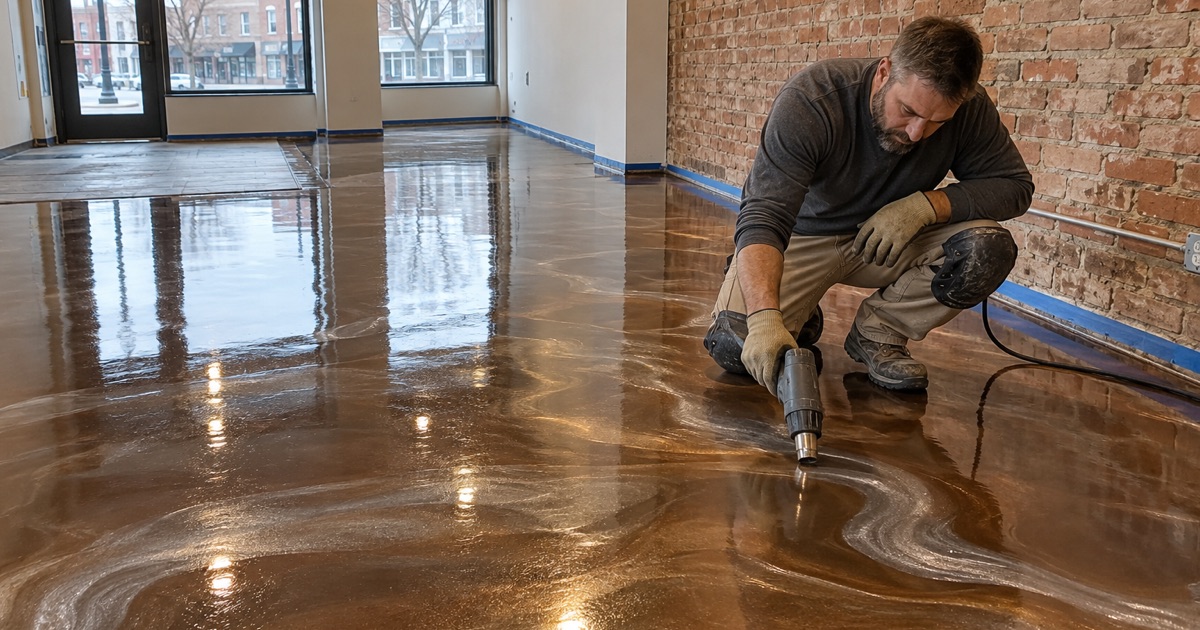
The metallic layer is a clear 100% solids epoxy loaded with metallic pigment, poured over the base and worked while it is still wet. Rollers, brushes, trowels and sprayed solvent or air move the pigment into veins, cells, ripples and soft clouds, and the effect depends on the technique, the timing and the room temperature. This is the step where experience shows most.
Because the resin keeps moving until it begins to gel, the pattern settles as it cures. No two metallic floors look alike, and even two rooms poured the same day will differ, which is part of the appeal for most owners.
Protective Topcoat
Epoxy alone scratches and can amber where sunlight reaches it. We finish metallic floors with a clear polyurethane, polyaspartic or polyurea topcoat that is UV stable and more abrasion resistant than the epoxy beneath it. That layer protects the decorative work and can be recoated later without disturbing the metallic pour underneath.
The topcoat can be high gloss for the deepest look or satin to soften glare and hide fine scratches. A fine anti-slip aggregate can also be added where the floor may get wet.
Where Metallic Floors Work Best
Finished Basements and Living Spaces
A finished basement is the most common home for a metallic floor around Waukesha. The finish makes a lower level feel brighter and more like a living space, it cleans easily, and it works well with area rugs and furniture. Moisture testing is especially important here, because a below-grade slab is in contact with damp soil and a reflective finish shows any moisture failure immediately.
We plan basement pours around dehumidification and the dew point spread at the slab surface, so condensation on a cool summer slab never ends up trapped under the metallic layer.
Showrooms, Offices and Retail Spaces
Metallic floors suit showrooms, offices, salons, studios and retail spaces where the floor is part of the design. The seamless surface cleans easily, and colors can be chosen to match a brand or interior palette. In commercial spaces we plan the pour around business hours, closing off one area at a time where the layout allows.
Where carts, heavy rolling loads or constant grit will cross the floor, we talk through the topcoat choice and the maintenance plan before the pour. A busy entry needs walk-off mats, especially through the winter salt season.
Why We Steer Most Garages Elsewhere
In a Waukesha garage, a metallic floor faces hot tires, road salt brine, sand and dropped tools, all of which show on a smooth, glossy surface much sooner than on a broadcast floor. Most garage owners are better served by a full flake system with a polyaspartic topcoat, and we say so. If you still want a metallic garage, we specify a heavier topcoat and a texture additive and explain the maintenance it will need.
Colors, Design Choices and Expectations
Choosing Colors and Effects
Metallic pigments come in silvers, golds, coppers, bronzes, blues, greens and many blended tones, and they can be layered over contrasting base colors. Subtle single-color floors read as soft stone, while two or three colors worked together produce strong veining and movement. Sample boards in your exact colors are part of every metallic proposal.
We also help you think about the room. Light colors brighten a basement but show dust; darker tones look rich but show scratches and footprints more readily. The best choice balances the look you want with how the space is used day to day.
What Drives the Cost of a Metallic Floor
A metallic floor costs more than a solid color or flake system because it uses more layers, more resin and much more skilled labor. The pour itself is only part of the price. Grinding and flattening a slab to the standard a reflective finish demands, filling cracks and low spots, and any moisture-mitigation primer the readings call for often make the biggest difference between two quotes.
The number of colors, the complexity of the effect, and the choice of topcoat also move the price. Each of those appears as its own line in our proposal, so you can see where a simpler single-color design or a satin topcoat would bring the total down without changing the slab work underneath.
Borders, Inlays and Mixed Finishes
Metallic floors can be combined with other systems in the same space. A metallic field framed by a solid color border, a saw-cut line separating a lounge from a work area, or a logo set into a showroom entry all add a design layer without covering the whole floor in one effect. We plan those transitions around the existing control joints so they stay crisp as the slab moves through the seasons.
In a basement that also holds a workshop or laundry, a hard-wearing flake floor in the utility end and a metallic finish in the living area often makes more sense than one system everywhere. We map the rooms with you at the estimate and price each area for the system it needs.
Moisture, Warranty and the Contract
Most coating warranties exclude failure caused by moisture coming up through the slab, and on a decorative floor that exclusion matters a great deal. We test before we pour, use a mitigation primer where the readings call for one, and read the warranty exclusions out before the job is sold. The products, colors and warranty go into the written contract, which every homeowner receives before a deposit is taken.
Dust Control During Prep
Grinding for a metallic floor is thorough, so dust control matters inside an occupied home or business. Our grinders run with vacuum dust collection, the work area is closed off, and swept dust and slurry are bagged and hauled away rather than washed into a floor drain or storm sewer.
- 20+ Years Coating Concrete
- Moisture Testing in Every Scope
- Written Contract Before Any Deposit